


AfroMundo Festival: “Re-imaginings: Power & Transformation”
Tuesday, April 14, 2026
7:00 pm
NHCC | Bank of America Theatre
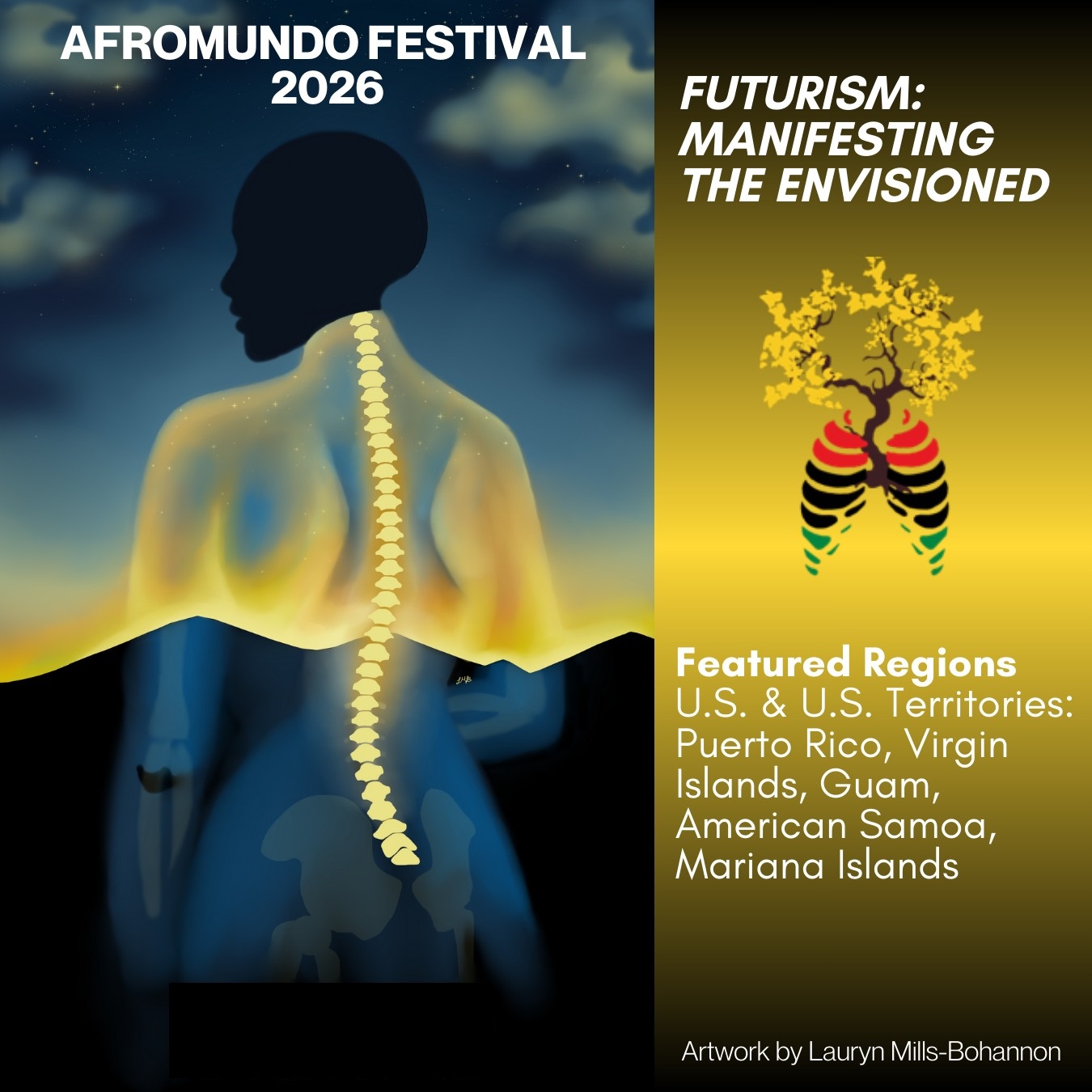
2026 AfroMundo Festival: “Futurism: Manifesting the Envisioned”
Featured Regions: U.S. & U.S. Territories: Puerto Rico, Virgin Islands, Guam, American Samoa, Mariana Islands
Screening of Puerto Rican documentary “The Bee—A Reflection on Women, Land, and Occupation.” Directed by Nelson Varas-Diaz. 2024. 30m. Followed by a panel discussion and Q&A. Panelists include award-winning afro-diasporic siblings, mulowayi and mapenzi who together comprise Las Nietas de Nonó; Afro-Puerto Rican attorney and former member of the Puerto Rican Senate, Ana Irma Rivera Lassén; Robert Washington-Vaughns, founder of Black Men Flower Project; and Tyeshia ‘Ty’ Wilson, Certified Impact Philanthropy Advisor and award-winning Giving Circle expert. Moderated by Latinx, transfeminist sociologist, Amaury J. Rijo Sanchez.
The 2026 AfroMundo Festival is free to the general public with limited seating and includes films, concerts, literature, oral traditions, panel discussions, culinary and other arts to foster a greater understanding of our shared humanity. Learn more at afromundo.org.
PLEASE MAKE YOUR RESERVATION HERE!
Las Nietas de Nonó are the afro-diasporic siblings, mulowayi and mapenzi. In their creative process, they evoke ancestral memory through personal archives. Their practice incorporates performance, found objects, organic materials, ecology, fiction, video and installation. In 2022, their solo show, Posibles Escenarios, Vol. 1 LNN was presented at Artists Space, New York a grouping of newly commissioned multimedia works that extend Las Nietas’s explorations of themes such as processes of expropriation and colonial violence against Black communities and the development of microhistories in relation to geopolitics. They created Ilustraciones de la Mecánica in 2016 – a multimedia installation that was later commissioned by the 10th Berlin Biennale (2018) and the 79th Whitney Biennial (2019). They have received the Latinx Artist Fellowship from the US Latinx Art Forum (2022), the Rome Prize in Visual Art from the American Academy in Rome (2022), the United States Artist Award (2018), The Art of Change from the Ford Foundation (2017), and the Global Arts Fund from the Astraea Lesbian Foundation for Justice (2017 & 2020). Their art has been shown in Haiti, Cuba, the Dominican Republic, Puerto Rico, Ecuador, England, Germany, Italy, Norway, Scotland, and the United States. In 2019, they co-founded Parceleras Afrocaribeñas, an organization run by Black womxn, where spaces for environmental and racial justice are created in the face of industrial developments that threaten their barrio of San Antón, in Carolina, Puerto Rico. https://www.lasnietasdenono.com
Anna Irma Rivera Lassén, an Afro-Puerto Rican attorney and former member of the Puerto Rican Senate, was born on March 13, 1955, in Santurce, San Juan. Throughout her career, Lassén has been a steadfast champion for human rights, particularly focusing on issues of discrimination, gender violence, and socio-economic rights. Her commitment to justice was exemplified in her successful challenge against discriminatory courtroom attire rules in the 1980s, setting a precedent for gender equality. Her expertise and advocacy have garnered recognition from prestigious organizations, including the United Nations Economic Commission for Latin America and the Caribbean. Lassén’s leadership extends beyond legal circles. From 2012 to 2014, she was the head of the Bar Association of Puerto Rico, making history as the first Afro-Puerto Rican and openly lesbian individual to hold the position. Her tenure was marked by significant advancements in promoting gender equality and access to justice. Additionally, she has contributed to the legislative process, actively participating in assessments of bills aimed at advancing human rights protections in Puerto Rico. Her impact and dedication have been acknowledged through numerous awards and honors, including the “Medalla Senatorial Capetillo-Roqué” from the Puerto Rican Senate and the “Martin Luther King/Arturo Alfonso Schomburg Prize.” Notably, Anna was recognized as one of USA Today’s Women of the Year in 2023, further underscoring her influential contributions to society.
Robert Washington-Vaughns: Founder of Black Men Fower Project
Tyeshia ‘Ty’ Wilson is a Certified Impact Philanthropy Advisor, an award-winning giving circle expert, and a catalyst for collective action, driven by the belief that everyone is a philanthropist capable of creating positive social change. As Senior Director of Community at Philanthropy Together, Ty leverages her lived experiences and expertise in community organizing and coalition building to architect the organization’s global partnership and engagement strategy, connecting diverse stakeholders to expand the collective giving movement. An energizing public speaker and bold advocate for collaborative, community-led philanthropy, Ty has spoken to thousands of people and trained hundreds through Philanthropy Together’s flagship Launchpad programs. She serves as immediate past Chair of HERitage Giving Fund, the first Black giving circle in Texas, and sits on multiple national boards including RegisterHER, Philanos and the Women of Color in Fundraising and Philanthropy. Ty’s strategic, community leadership experience spans hospitality, fundraising, and government sectors. Notably, she previously served as Assistant to the City Manager and Chief of Staff at the City of Dallas. A proud Dallas native with deep Texas roots, Ty holds degrees from UT Arlington and UNT Dallas, and an Executive Certificate in Philanthropic Leadership from Georgetown University
MODERATOR—Amaury J. Rijo Sanchez: As a Latinx, transfeminist sociologist, Sanchez’ work explores the intersections of decoloniality, activist coalitions, and cultural and creative expressions, with focus on Latinx populations. Guided by a decolonial feminist lens, he investigates how feminist organizing and queer artivism resist colonial infrastructures and generate alternative modes of community-building and survival. Sanchez’ research draws from ethnographic methods and critical theory to highlight the significance of mobilization from the margins in shaping more just futures.